For decades, a colon cancer diagnosis almost always meant surgery. Today, that approach is evolving.
With advances in precision medicine, immunotherapy, and minimally invasive procedures, many patients now ask an important question:
Can colon cancer be cured without surgery?
The answer isn’t simple. It depends on:
- The stage of cancer
- The tumor’s genetic profile
- The patient’s overall health
In some cases—yes, it is possible.
Understanding the Enemy: Symptoms and Stages
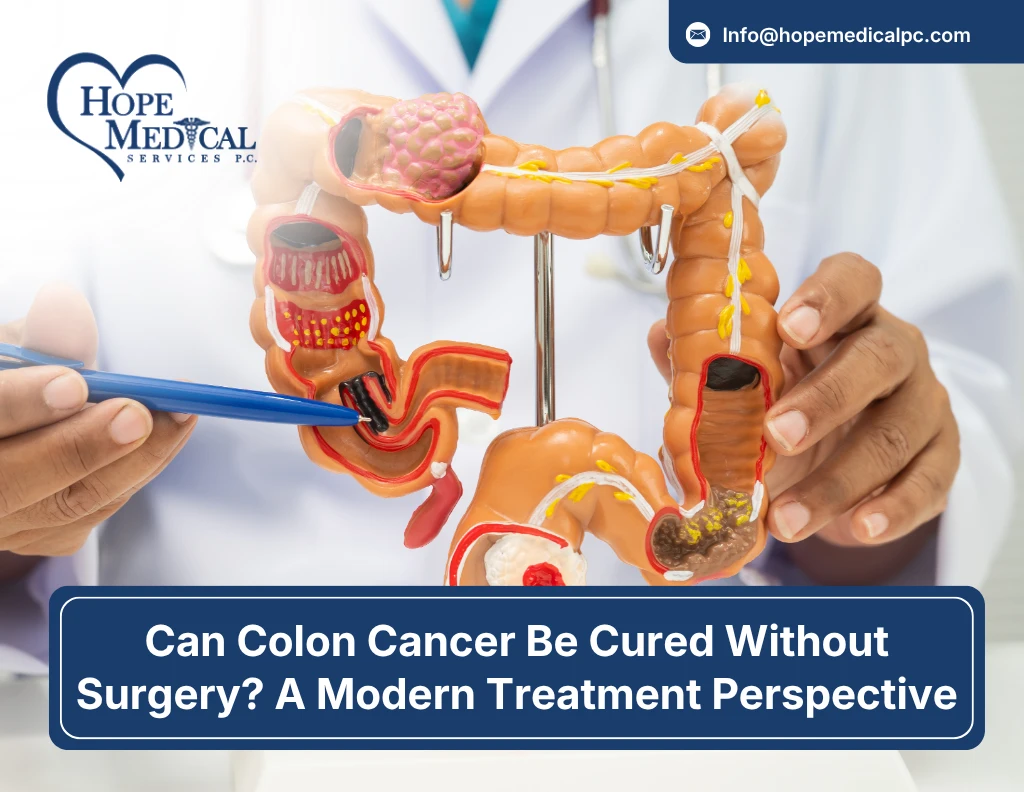
Before discussing cures, we must understand the progression. Colon cancer rarely appears overnight; it typically evolves from small growths called polyps.
Symptoms of Colon Cancer to Watch For
Early-stage colon cancer is notoriously “silent.” However, as the tumor grows or begins to bleed, patients may notice:
- Persistent changes in bowel habits: Diarrhea, constipation, or narrowing of the stool that lasts more than a few days.
- Rectal bleeding: Bright red blood or dark, tarry stools (indicating dried blood from higher up in the colon).
- Abdominal distress: Persistent cramps, gas, or pain.
- Unexplained weight loss: The body is consuming energy to fight the malignancy.
- Systemic fatigue: Often caused by anemia due to chronic, unseen blood loss.
Colon Cancer Stages and Treatment
Treatment is dictated by the TNM system (Tumor size, Node involvement, Metastasis)
| Stage | Description | Standard Treatment |
| Stage 0 | Cancer is limited to the innermost lining (mucosa). | Endoscopic removal (No traditional surgery). |
| Stage I | Cancer has grown into the muscle layer but not through it. | Surgical resection or advanced endoscopy. |
| Stage II | Cancer has grown through the colon wall but hasn’t hit the lymph nodes. | Surgery, sometimes followed by chemotherapy. |
| Stage III | Cancer has spread to nearby lymph nodes. | Surgery + Adjuvant Chemotherapy. |
| Stage IV | Cancer has spread to distant organs (liver, lungs). | Systemic therapy (Chemo, Immunotherapy, Targeted). |
Can Colon Cancer Be Cured Without Surgery?
“Cure” without a traditional operating room is possible in two specific scenarios: Early-Stage Endoscopy and Total Neoadjuvant Therapy (TNT).
Early-Stage Colon Cancer Treatment: The Endoscopic Revolution
For many patients, early-stage colon cancer treatment no longer requires “cutting” in the traditional sense.
- Polypectomy: If the cancer is confined entirely within a polyp, a gastroenterologist can snip it out during a routine colonoscopy.
- Endoscopic Mucosal Resection (EMR): Specially trained endoscopists use a “lift and cut” technique to remove shallow tumors from the colon wall without ever opening the abdomen.
The Non-Surgical Arsenal: Treatment of Colon Cancer
When surgery is not an option, either due to the patient’s health or the extent of the disease, other pillars of treatment take the lead.
Immunotherapy and Targeted Therapy
The most significant breakthrough in 2026 is the use of biomarkers.
- MSI-H/dMMR Tumors: Patients with these specific genetic markers often respond so dramatically to Immunotherapy (Checkpoint Inhibitors) that tumors shrink significantly, sometimes reaching a point where surgery is deferred or minimized.
- Targeted Therapy: Drugs like those targeting the BRAF or KRAS mutations “turn off” the signals that tell cancer cells to grow.
Ablation and Embolization
For Stage IV patients where the cancer has moved to the liver, Radiofrequency Ablation (RFA) or Cryoablation uses extreme heat or cold to “burn” or “freeze” tumors without a single incision.
Treatment of Colon Cancer (Modern Overview)
The treatment of colon cancer is no longer dependent on surgery alone. Today, oncologists use a personalized, multi-modal treatment approach based on the stage of cancer, tumor genetics, and overall patient health. This improves both survival rates and quality of life.
1. Surgery
Surgery remains the primary curative option, especially for early-stage colon cancer. The goal is to remove the tumor along with a margin of healthy tissue and nearby lymph nodes to prevent recurrence. In many early cases, surgery alone may be sufficient.
2. Chemotherapy
Chemotherapy is used when cancer has spread beyond the colon or lymph nodes, or when there is a high risk of recurrence. It works by targeting rapidly dividing cancer cells throughout the body and is often given after surgery (adjuvant therapy) or before surgery in advanced cases (neoadjuvant therapy).
3. Targeted Therapy
Targeted therapy focuses on specific molecular changes in cancer cells. It blocks pathways that help tumors grow and spread, such as KRAS, EGFR, and VEGF. This approach is often used in advanced or metastatic colon cancer and is selected based on genetic testing of the tumor.
4. Immunotherapy
Immunotherapy helps the body’s immune system recognize and attack cancer cells. It is particularly effective in patients with microsatellite instability-high (MSI-H) or mismatch repair-deficient (dMMR) tumors. These treatments can lead to long-lasting responses in selected patients.
5. Ablation Techniques
For localized or small metastatic tumors, minimally invasive ablation methods may be used. These include radiofrequency ablation, microwave ablation, or cryotherapy, which destroy cancer cells using heat, cold, or energy-based techniques without major surgery.
6. Palliative Care
In advanced stages, when a cure is not possible, palliative care focuses on relieving symptoms, controlling pain, and improving quality of life. It may be combined with other treatments to help patients live more comfortably and maintain dignity during care.
How Curable Is Colon Cancer?
Curability depends largely on early detection.
- Stage I: Very high cure rate
- Stage II: Strong outcomes with treatment
- Stage III: Still curable with combined therapy
- Stage IV: Rarely curable, but manageable
Early diagnosis dramatically improves survival.
Colon Cancer Survival Rate
Colon cancer survival rates provide a general idea of outcomes but cannot predict an individual patient’s exact prognosis. They vary significantly depending on the stage at diagnosis and how early treatment begins. With advances in modern medicine, survival outcomes have improved over the years.
Overall Survival Trends:
- All stages combined: around 60%+ 5-year survival in many populations
- Early-stage patients: significantly higher survival rates, often very favorable
- Advanced-stage patients: lower survival rates, but improving due to modern treatments
Major Factors Influencing Survival:
- Early diagnosis through timely screening and detection
- Access to effective surgical treatment when needed
- Response to chemotherapy and advanced therapies
Patients diagnosed at an early stage often achieve long-term survival or even complete remission, especially when treatment is started promptly.
What Happens If Colon Cancer Goes Untreated?
- The tumor continues to grow and gradually becomes more aggressive
- It may cause bowel obstruction, leading to severe abdominal complications
- Internal bleeding can occur, often resulting in anemia, fatigue, and weakness
- Cancer can spread to distant organs such as the liver, lungs, and lymph nodes
- Without treatment, the disease steadily worsens, and overall health declines
- Survival time decreases significantly in untreated cases
- In advanced stages, survival may be reduced from years to only a few months
- Once metastasis occurs, the cancer becomes much harder to control or manage
- Treatment focus shifts from cure to symptom relief and life prolongation
- Care becomes primarily palliative to improve comfort and quality of life
Conclusion
Colon cancer is a serious but increasingly treatable condition when detected early and managed with a modern, multidisciplinary approach. From surgery and chemotherapy to targeted therapy and immunotherapy, treatment options today are more advanced and personalized than ever before.
Understanding symptoms, stages, and available treatment options can help patients seek timely medical attention and avoid complications associated with late-stage disease. For more detailed information, treatment guidance, and healthcare support, you can visit Hope Medical PC. The key factor that consistently improves outcomes is early diagnosis, which significantly increases survival and curability rates.
FAQs
Q1. Who is at higher risk of developing colon cancer?
People with a family history of colon cancer, long-standing inflammatory bowel disease (like Crohn’s or ulcerative colitis), obesity, smoking habits, and a low-fiber, high-processed food diet are at higher risk.
Q2. Can colon cancer be prevented with lifestyle changes?
While it cannot be fully prevented, the risk can be significantly reduced by maintaining a high-fiber diet, exercising regularly, limiting red and processed meats, avoiding smoking, and reducing alcohol intake.
Q3. How often should someone get screened for colon cancer?
For average-risk individuals, screening usually starts at age 45 and is repeated every 10 years if results are normal.
Q4. What is the role of genetic testing in colon cancer?
Genetic testing helps identify inherited conditions like Lynch syndrome, which significantly increase colon cancer risk.
Q5. Can colon cancer come back after treatment?
Yes, recurrence is possible depending on the stage and biology of the tumor. That’s why regular follow-ups, scans, and blood tests are essential even after successful treatment.
Q6. Can colon cancer be detected with a simple blood test?
No single blood test can diagnose colon cancer. Blood tests may support diagnosis or monitoring, but colonoscopy remains the most reliable method for detection.