Marfan syndrome is a genetic condition that affects the body’s connective tissue, the material that holds bones, muscles, blood vessels, and organs together. Because connective tissue is found almost everywhere in the body, Marfan syndrome can affect the heart, eyes, skeleton, skin, and lungs all at once.
If you or a loved one has recently been diagnosed, the first question is almost always the same one: can Marfan syndrome be cured? The honest answer is how the condition is treated, managed day to day, and monitored so that people with Marfan syndrome can live full, active lives.
What Is Marfan Syndrome?
Marfan syndrome is caused by a change (mutation) in the FBN1 gene, which is responsible for making fibrillin-1, a protein that gives connective tissue its strength and flexibility. When this protein doesn’t work properly, connective tissue throughout the body becomes weaker and more elastic than it should be.
- Inherited condition: In most cases, it is passed down from a parent, though about 25% of cases occur from a new, spontaneous gene change.
- Affects multiple systems: The cardiovascular system, eyes, skeleton, skin, and lungs are the most commonly involved.
- Wide range of severity: Some people have mild features; others have serious, life-threatening complications, particularly involving the aorta.
- Estimated prevalence: Roughly 1 in 5,000 people worldwide are believed to have Marfan syndrome.
Common Signs and Symptoms of Marfan Syndrome
Because Marfan syndrome affects connective tissue throughout the body, its signs can appear in the skeleton, eyes, skin, and cardiovascular system long before a formal diagnosis is made. Recognizing these features early can prompt a referral for genetic testing and cardiac imaging, which is often the first real step toward protection.
- Tall, slender build: Long arms, legs, fingers, and toes are among the most recognizable physical traits.
- Flexible joints: Unusually loose joints that bend further than average (hypermobility).
- Chest wall changes: A chest that caves in (pectus excavatum) or protrudes outward (pectus carinatum).
- Curved spine: Scoliosis is common and can worsen quickly during growth spurts.
- Vision changes: Severe nearsightedness or a dislocated lens, sometimes noticed as sudden blurry vision.
- Flat feet and a high, arched palate: Additional skeletal features often noted during a physical exam.
Not every person with Marfan syndrome shows all of these traits, and some features only become noticeable with age. This is exactly why family history and genetic testing carry as much weight as the physical exam when confirming a diagnosis.
Can Marfan Syndrome Be Cured?
The direct answer is no; Marfan syndrome cannot currently be cured. Because it is caused by a permanent genetic change present in nearly every cell of the body, there is no medication, surgery, or therapy that can remove or reverse the underlying mutation. However, this does not mean the condition cannot be controlled.
Modern medicine has transformed Marfan syndrome from a condition that once significantly shortened life expectancy into one that, with proper care, allows most patients to live close to a normal lifespan. The goal of care is not to cure the gene mutation but to prevent, delay, or manage the complications it causes.
Why a Cure Isn’t Available Yet
- Marfan syndrome is a genetic disorder present from birth in every cell containing the FBN1 mutation.
- Gene therapy for connective tissue disorders is still in early research stages and is not yet an approved treatment.
- Current medical strategies target the effects of the mutation (weak connective tissue) rather than the mutation itself.
Can Marfan Syndrome Be Treated?
Yes. While Marfan syndrome cannot be cured, it can absolutely be treated. Treatment focuses on slowing disease progression, protecting the aorta, correcting skeletal and eye problems, and catching complications early through regular screening.
| Body System | Common Treatment Approach |
| Heart & Aorta | Beta-blockers or ARBs (e.g., losartan), regular echocardiograms, activity guidance, preventive surgery when needed |
| Eyes | Corrective lenses, monitoring for lens dislocation, cataract or retinal detachment surgery if required |
| Skeleton | Bracing for scoliosis, physical therapy, orthopedic surgery for severe spine or chest wall deformities |
| Lungs | Monitoring for pneumothorax (collapsed lung), treatment of sleep apnea if present |
| Skin & Joints | Physical therapy, joint protection strategies, management of stretch marks or hernias |
How Is Marfan Syndrome Managed?
Long-term management of Marfan syndrome relies on a coordinated care team and consistent follow-up. Because the condition can quietly progress without obvious symptoms, especially in the aorta, routine monitoring is the backbone of safe, effective management.
Core Elements of Ongoing Management
Regular cardiac imaging: Echocardiograms and sometimes CT or MRI scans, to track the size of the aorta over time.
- Medication adherence: Beta-blockers or angiotensin receptor blockers to reduce stress on the aortic wall.
- Annual eye exams: To detect lens dislocation, nearsightedness, glaucoma, or retinal issues early.
- Orthopedic follow-up: Monitoring spinal curvature and bone growth, especially during adolescence.With a high risk of chest trauma or sudden exertion.
- Genetic counseling: For family planning and to help relatives understand their own risk.
- Multidisciplinary care team: Cardiologist, ophthalmologist, orthopedic specialist, and geneticist working together.
- Regular cardiac imaging, including echocardiogram testing, to track the size of the aorta over time.
Because Marfan syndrome is a lifelong condition, management is never a one-time event; it is an ongoing partnership between the patient and their care team. Appointments that feel routine, such as an annual echocardiogram, are often the very tool that catches a slowly enlarging aorta before it becomes dangerous.
Skipping these visits, even when someone feels perfectly healthy, is one of the most common and most preventable risk factors for a serious complication.
| Life Stage | Management Focus |
| Childhood | Growth monitoring, early scoliosis screening, baseline eye and heart exams |
| Adolescence | Close tracking of rapid growth spurts, aortic monitoring, activity counseling |
| Adulthood | Routine imaging, medication management, family planning discussions |
| Pregnancy | High-risk obstetric care with close cardiology involvement due to added strain on the aorta |
How Does Marfan Syndrome Affect the Heart?
The cardiovascular system is the most important focus in Marfan syndrome because it carries the greatest risk to life. Weakened connective tissue affects the walls of the aorta, the large artery that carries blood from the heart to the rest of the body, as well as the heart valves.
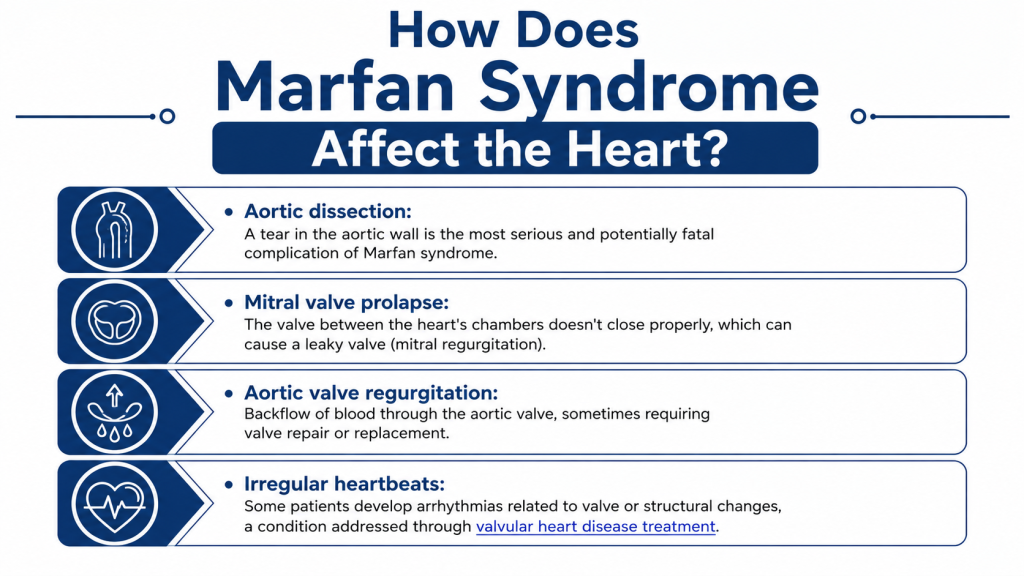
- Aortic dilation: The aorta gradually widens, increasing the risk of a tear (dissection) or rupture.
- Aortic dissection: A tear in the aortic wall is the most serious and potentially fatal complication of Marfan syndrome.
- Mitral valve prolapse: The valve between the heart’s chambers doesn’t close properly, which can cause a leaky valve (mitral regurgitation).
- Aortic valve regurgitation: Backflow of blood through the aortic valve, sometimes requiring valve repair or replacement.
- Irregular heartbeats: Some patients develop arrhythmias related to valve or structural changes, a condition addressed through valvular heart disease treatment.
Because these changes often develop silently, routine echocardiograms are essential even for patients who feel completely healthy. Doctors track the diameter of the aorta closely because risk of dissection rises sharply once it passes certain size thresholds.
This is why cardiologists don’t simply check whether the aorta is enlarged; they track its growth rate over months and years, comparing each new scan to the last. A small aorta that is growing quickly can sometimes carry more concern than a slightly larger one that has stayed stable for years.
What Complications Can Marfan Syndrome Cause?
Marfan syndrome can affect nearly every organ system. Recognizing potential complications early allows for timely treatment and significantly improves outcomes.
| System | Possible Complications |
| Cardiovascular | Aortic aneurysm, aortic dissection, valve regurgitation, arrhythmia |
| Skeletal | Scoliosis, chest wall deformities (pectus excavatum/carinatum), joint hypermobility, flat feet |
| Eyes | Lens dislocation, severe nearsightedness, early cataracts, retinal detachment, glaucoma |
| Lungs | Spontaneous pneumothorax (collapsed lung), sleep apnea |
| Skin | Stretch marks unrelated to weight change, hernias |
| Dura (spinal lining) | Dural ectasia, causing lower back pain |
Not everyone with Marfan syndrome experiences every complication, and severity varies widely even within the same family. This is why individualized, ongoing monitoring matters more than a one-size-fits-all treatment plan.
When Is Surgery Needed for Marfan Syndrome?
Surgery is not needed by every patient, but it plays a critical, often life-saving role for many people with Marfan syndrome, particularly when the aorta reaches a size that puts it at risk of tearing.
Common Indications for Surgery
- Aortic root enlargement: Preventive surgery is typically considered once the aortic root reaches a specific size threshold determined by a cardiologist.
- Rapid aortic growth: Even below the standard threshold, fast-growing aneurysms may prompt earlier surgery.
- Aortic dissection: This is a medical emergency requiring immediate surgical repair.
- Severe valve regurgitation: Valve repair or replacement may be needed if leakage significantly affects heart function.
- Severe scoliosis: Spinal fusion surgery may be recommended when curvature is severe or progressing quickly.
- Chest wall deformities: Surgery may be considered if the deformity affects breathing, heart function, or causes significant distress.
- Recurrent pneumothorax: Repeated lung collapses may require a surgical procedure to prevent recurrence.
| Surgery Type | Purpose |
| Aortic root replacement | Replaces the weakened section of the aorta with a graft to prevent rupture or dissection |
| Valve-sparing aortic surgery | Repairs the aortic root while preserving the patient’s own valve |
| Mitral or aortic valve repair/replacement | Restores proper valve function and blood flow |
| Spinal fusion | Corrects and stabilizes severe scoliosis |
| Pectus repair | Corrects chest wall deformities affecting breathing or heart space |
Timing matters. Elective, planned surgery on the aorta is far safer and more successful than emergency surgery after a dissection has already occurred; another reason regular imaging is so important.
Patients with structural or inherited heart conditions can benefit from ongoing adult congenital and structural heart disease treatment alongside genetic counseling.
Can People With Marfan Syndrome Live a Normal Life?
Yes, with proper diagnosis, consistent monitoring, and appropriate treatment, most people with Marfan syndrome can live long, active, and fulfilling lives. Decades ago, life expectancy for Marfan syndrome was significantly reduced, largely due to undetected aortic complications. Today, with early diagnosis and modern cardiovascular care, many patients live into their 70s or beyond.
Tips for Living Well With Marfan Syndrome
- Keep every scheduled cardiology and ophthalmology appointment, even without symptoms.
- Choose low-impact exercise such as walking, swimming, or cycling over high-intensity or contact sports.
- Take prescribed medications consistently, even when feeling well.
- Wear a medical alert bracelet noting the Marfan diagnosis in case of emergency.
- Discuss pregnancy planning with a cardiologist beforehand, as pregnancy adds strain to the aorta.
- Seek support from genetic counselors, patient communities, or mental health professionals as needed.
Many people with Marfan syndrome pursue careers, raise families, and stay physically active; the key difference-maker is a proactive, well-managed care plan rather than a reactive one.
Bottom Line
Marfan syndrome cannot be cured, but it can be effectively treated and managed. For personalized guidance on protecting the heart and aorta over the long term, the specialists at Hope Medical Services combine routine monitoring, timely medication, and surgery when needed so that patients can lead full, active lives.
The single most important step is early diagnosis followed by consistent, lifelong follow-up with a knowledgeable care team because with Marfan syndrome, prevention and monitoring are what protect the heart, the eyes, and everything in between.