A failing heart valve rarely announces itself with a single dramatic moment. It shows up as a little more breathlessness on the stairs, a nap that turns into two hours, ankles that stay swollen by dinnertime. Most people quietly adjust their lives around it long before they ever say the words “heart valve disease” out loud.
You will get to know how valve disease develops, the symptoms that deserve a same-week appointment, and how doctors decide between valve repair, surgical replacement (SAVR), and the minimally invasive TAVR procedure, with a dedicated look at what changes when the patient is 75, 80, or 90 years old.
What Is Heart Valve Disease?
Your heart has four one-way valves, the aortic, mitral, tricuspid, and pulmonary, that open and close roughly 100,000 times a day to keep blood moving in a single direction. Valve disease develops when one of these valves stops working the way it should. There are two basic malfunctions, and a valve can suffer from either one or both at once:
- Stenosis: the valve opening becomes narrowed or stiff, often from calcium buildup, forcing the heart to pump harder to push blood through a smaller gap.
- Regurgitation (or insufficiency): the valve does not close completely, so blood leaks backward instead of moving forward, reducing how efficiently the heart circulates blood.
The aortic and mitral valves are involved in the vast majority of clinically significant cases, largely because they sit on the left side of the heart, which does the heavier work of pumping blood to the entire body. Aortic stenosis in particular is the most common valve condition diagnosed in older adults in the United States.
Recognizing the Symptoms of a Failing Heart Valve
Valve disease is a master of disguise in its early stages. The heart compensates for months or years, which is exactly why so many patients are surprised when a routine echocardiogram reveals a valve that is already moderately or severely diseased. The symptoms below are the ones that most often prompt a diagnosis, but they are also symptoms people commonly blame on “just getting older.”
| Symptom | What Patients Usually Say | Why It Happens |
| Shortness of breath | “I get winded doing things that never used to bother me.” | The heart cannot move enough oxygen-rich blood forward, so fluid backs up into the lungs. |
| Fatigue and low stamina | “I need a nap by early afternoon.” | Reduced blood flow means muscles and organs receive less oxygen. |
| Chest tightness or pain | “It feels like pressure, not a sharp pain.” | A narrowed valve forces the heart muscle to work harder than its own blood supply can support. |
| Swelling in the legs, ankles, or abdomen | “My shoes fit differently by evening.” | Backward blood flow raises pressure in the veins, pushing fluid into surrounding tissue. |
| Dizziness or fainting | “I felt lightheaded standing up too fast.” | A stiff valve limits how much blood reaches the brain during exertion. |
| Heart palpitations | “My heart feels like it skips or flutters.” | Valve strain can trigger irregular rhythms such as atrial fibrillation. |
| A new heart murmur | Usually found by a doctor, not felt by the patient. | Turbulent blood flow through a narrowed or leaking valve creates an audible whooshing sound. |
What Causes Heart Valves to Fail?
Valve disease develops for different reasons depending on age, and understanding the cause helps guide treatment timing.
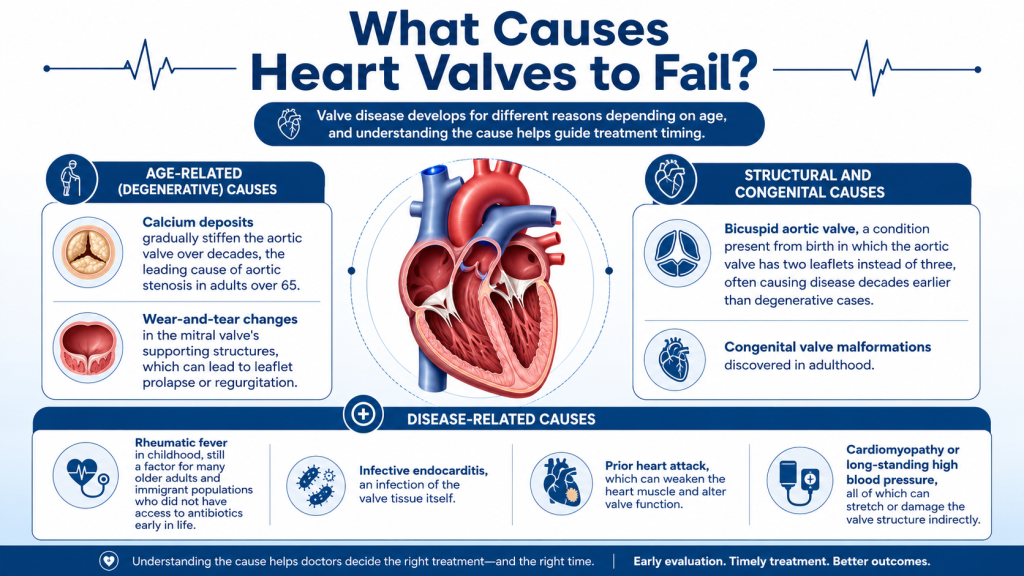
- Age-related (degenerative) causes
- Calcium deposits gradually stiffen the aortic valve over decades, the leading cause of aortic stenosis in adults over 65.
- Wear-and-tear changes in the mitral valve’s supporting structures, which can lead to leaflet prolapse or regurgitation.
- Structural and congenital causes
- Bicuspid aortic valve, a condition present from birth in which the aortic valve has two leaflets instead of three, often causing disease decades earlier than degenerative cases.
- Congenital valve malformations discovered in adulthood.
- Disease-related causes
- Rheumatic fever in childhood, still a factor for many older adults and immigrant populations who did not have access to antibiotics early in life.
- Infective endocarditis, an infection of the valve tissue itself.
- Prior heart attack, cardiomyopathy, or long-standing high blood pressure, all of which can stretch or damage the valve structure indirectly.
How Cardiologists Diagnose Valve Disease
Diagnosis almost always starts with a stethoscope. A murmur picked up during a routine physical is often the first clue, followed by imaging to confirm the diagnosis and measure severity.
| Test | What It Shows | Typical Setting |
| Echocardiogram | Detailed images of valve structure, blood flow direction, and pumping function | In-office, painless, 30–45 minutes |
| Electrocardiogram (EKG) | Heart rhythm and signs of strain on the heart’s electrical activity | In-office, a few minutes |
| Holter monitor | Rhythm tracking over 24–48 hours to catch intermittent arrhythmias linked to valve strain | Worn at home |
| Transesophageal echocardiogram (TEE) | A closer, more detailed view of the valves from inside the esophagus | Outpatient procedure, mild sedation |
| Cardiac catheterization | Pressure measurements and coronary artery evaluation before surgery | Hospital-based procedure |
| CT angiography | Precise sizing of the aortic valve and vessels for TAVR planning | Outpatient imaging center |
Severity is generally classified as mild, moderate, or severe based on valve opening size, blood flow velocity, and pressure gradients. This classification, along with whether symptoms are present, is what determines whether a patient is monitored, medicated, or scheduled for a procedure.
Treatment Options: From Monitoring to Replacement
Not every diseased valve needs to be replaced immediately, and not every patient needs surgery at all. Treatment is staged according to how severe the disease is and whether it is producing symptoms.
1. Watchful Waiting with Regular Monitoring
Mild to moderate valve disease without symptoms is often managed with scheduled echocardiograms every one to two years, blood pressure control, and management of cholesterol, since valve calcification shares risk factors with coronary artery disease.
2. Medications
No medication reverses a stiffened or leaking valve, but medications help manage the downstream effects: diuretics to reduce fluid buildup, blood pressure medications to ease the heart’s workload, and blood thinners for patients with related arrhythmias like atrial fibrillation.
3. Valve Repair
When anatomically feasible, especially for mitral valve regurgitation, surgeons can repair the patient’s own valve tissue rather than replace it. Repair preserves the natural valve, avoids the need for lifelong blood thinners in many cases, and is generally associated with excellent long-term durability when performed at an experienced center.
4. Valve Replacement
When repair is not possible, or the valve is too diseased, the damaged valve is replaced with either a mechanical valve (durable, but requires lifelong blood-thinning medication) or a biological (bioprosthetic) valve made from treated animal tissue, which does not require long-term blood thinners but may wear out sooner, typically within 10 to 20 years.
SAVR vs. TAVR at a Glance
| Factor | Surgical Aortic Valve Replacement (SAVR) | Transcatheter Aortic Valve Replacement (TAVR) |
| How it’s done | Open-heart surgery through the chest, using a heart-lung bypass machine | Catheter-based, usually through an artery in the groin, no chest incision |
| Typical hospital stay | 5–7 days | 1–2 days |
| Recovery time | 6–12 weeks | 1–2 weeks for most daily activities |
| Best suited for | Younger, lower-risk patients, or those needing another cardiac procedure at the same time | Older adults or anyone at intermediate-to-high surgical risk |
| Long-term data | Decades of outcome data across all age groups | Strong outcome data, including in low-risk patients, though longest follow-up is still shorter than SAVR’s |
Heart Valve Replacement in Elderly Patients
Age is one of the most important factors in deciding how, not whether, to treat a failing valve. Current cardiology guidelines generally favor TAVR for patients over 80 and generally favor surgery for patients under 65, with a case-by-case decision zone in between based on frailty, other health conditions, and valve anatomy.
Why TAVR is often preferred for older adults
- No chest incision and no heart-lung bypass machine, which meaningfully lowers physical stress on an aging body.
- Shorter hospital stays reduce the risk of hospital-acquired complications, including delirium and deconditioning, both of which disproportionately affect older patients.
- Many elderly patients return to baseline activity within one to two weeks rather than the two to three months typical of open-heart recovery.
- TAVR can be performed under moderate sedation in appropriately selected patients, avoiding some of the risks associated with general anesthesia in frail individuals.
What families should still ask about
- Frailty assessment: strength, mobility, nutrition, and cognitive status all factor into whether a patient will tolerate either procedure well, independent of age alone.
- Valve durability: because TAVR was originally used mainly in elderly, high-risk patients, most available long-term data reflects that population, which is reassuring for older patients specifically.
- Need for a pacemaker: TAVR carries a somewhat higher chance of requiring a permanent pacemaker afterward compared with surgical replacement.
- Multidisciplinary heart team review: the strongest programs evaluate every valve case through a team of cardiologists and surgeons together, not a single specialist in isolation.
For patients in their 80s and 90s who are otherwise engaged in life, whether that means gardening, caring for grandchildren, or simply wanting to breathe easily on a walk, TAVR has changed what is realistically possible. Procedures that would once have been considered too risky for advanced age are now routine at experienced centers, provided the patient is carefully evaluated first.
Recovery After Valve Replacement: What to Expect
| Timeframe | SAVR (Open-Heart Surgery) | TAVR (Catheter-Based) |
| First 48 hours | ICU monitoring, breathing exercises, first steps with assistance | Monitoring for rhythm changes, usually walking same day or next morning |
| First 2 weeks | Hospital discharge planning, incision care, very limited lifting | Most patients resume light daily activities |
| 6 weeks | Driving may resume with clearance; cardiac rehab often begins | Follow-up echocardiogram to confirm valve function |
| 3 months | Chest bone typically healed; return to most normal activities | Full return to prior activity level for most patients |
| Ongoing | Annual or biannual echocardiograms; lifelong follow-up | Annual or biannual echocardiograms; lifelong follow-up |
When to Talk to a Cardiologist
If you or an aging parent has noticed new breathlessness, unexplained fatigue, ankle swelling, or a murmur mentioned at a checkup, it is worth having that valve evaluated properly rather than waiting for symptoms to worsen. An echocardiogram is painless, takes under an hour, and gives a clear picture of exactly how a valve is functioning today.
Our Valvular Heart Disease Treatment program covers everything from initial diagnosis and ongoing monitoring to coordinating surgical or transcatheter valve procedures through our hospital affiliations when a replacement is needed.
Final Thoughts
Heart valve disease rarely knocks loudly. It shows up as an extra pillow at night, a shorter walk than usual, a murmur your doctor mentions almost in passing. The good news is that valve disease is one of the most treatable conditions in cardiology today, and age is no longer the barrier it once was. Whether the right path is watchful waiting, a repair, or a replacement like TAVR or SAVR, the decision comes down to catching the problem early and matching the treatment to the person, not just the diagnosis.
At Hope Medical Services P.C., our cardiology team evaluates valve disease using in-office echocardiograms and advanced diagnostics, then builds a monitoring or treatment plan suited to each patient’s age, lifestyle, and overall health.
FAQs
Q1. Can a heart valve problem go away on its own?
No. Valve disease does not reverse itself. Mild cases can remain stable for years with monitoring, but moderate to severe disease typically progresses over time.
Q2. Is heart valve replacement considered major surgery?
SAVR is major open-heart surgery. TAVR is a minimally invasive procedure and is often described by patients as far less taxing than expected, though it is still a significant cardiac intervention that requires careful evaluation.
Q3.How long does a replacement valve last?
Mechanical valves are built to last a lifetime but require daily blood thinners. Biological valves typically last 10 to 20 years depending on the patient’s age and the valve position, and a worn bioprosthetic valve can often be treated with a second, less invasive valve-in-valve procedure rather than repeat open surgery.
Q4. At what age is someone considered too old for valve replacement?
There is no strict age cutoff. Decisions are based on overall health, frailty, other medical conditions, and the patient’s own goals, not age alone. Patients in their 90s can be, and routinely are, successfully treated.
Q5. What happens if a failing valve is left untreated?
Untreated severe valve disease can lead to heart failure, dangerous arrhythmias, and a significantly shortened life expectancy.