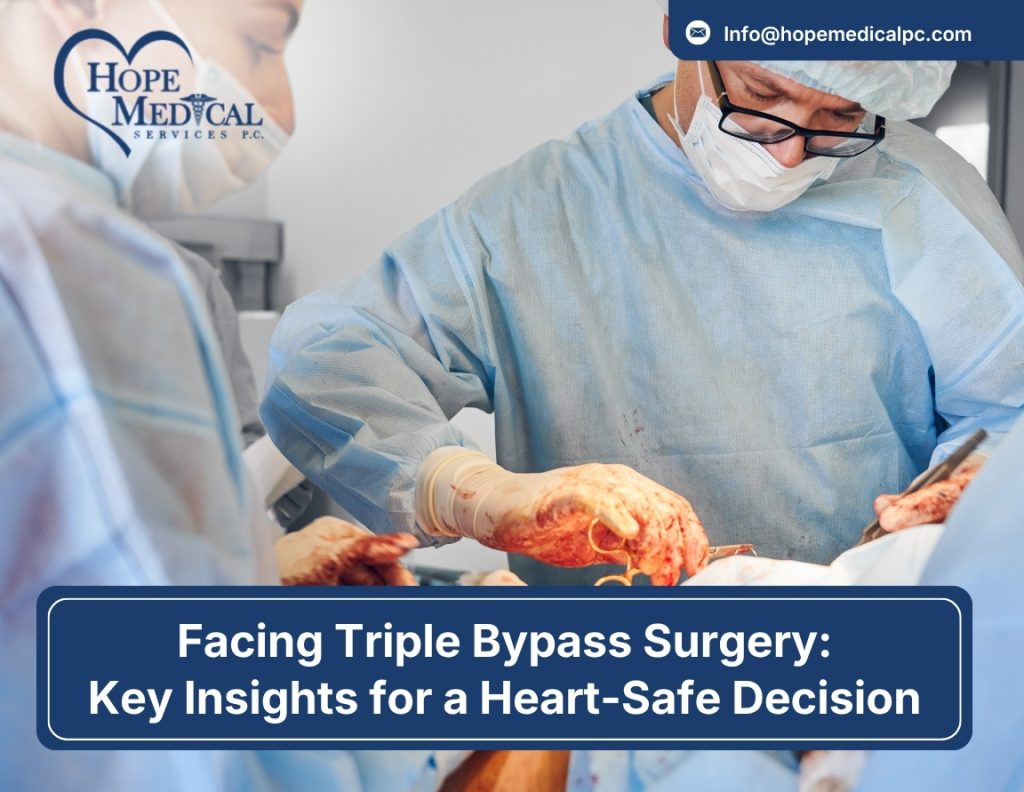
Triple bypass surgery, formally known as triple coronary artery bypass grafting (CABG), is one of the most performed major cardiac surgeries in the world, and also one of the most misunderstood. When a cardiologist tells a patient they need a triple bypass, the reaction is often immediate fear.
And that fear is not entirely unwarranted. But context matters enormously here: the risk of the surgery must always be weighed against the risk of not having it. For many patients, an unrevascularized heart with three blocked arteries is a ticking clock.
Is Triple Bypass Surgery Common? More Than Most People Realize
Triple CABG is not a rare or experimental procedure. In the United States alone, approximately 200,000 coronary artery bypass surgeries are performed annually, with triple-vessel bypass accounting for a substantial portion of those cases. Triple and quadruple bypass procedures together represent the majority of all CABG surgeries performed, meaning most bypass patients have multi-vessel disease, not just a single blocked artery.
The widespread prevalence of this procedure means that surgical teams at major cardiac centers have performed hundreds or thousands of these operations. Experience matters: centers that perform higher volumes of CABG procedures consistently report lower complication and mortality rates. For patients considering where to have this surgery done, volume and specialization are among the most important factors to investigate.
Triple Bypass Surgery: Key Statistics at a Glance
| Metric | Data / Range |
| Annual CABG surgeries (US) | ~200,000+ |
| Mortality in low-risk patients (<65, no comorbidities) | 2–5% (population average) |
| Mortality in low-risk patients (<65, no comorbidities) | Under 1–2% |
| Mortality in high-risk patients (elderly, diabetic, renal) | 5–10% or higher |
| 10-year survival rate after triple bypass | ~60–80% (age-dependent) |
| Average surgery duration | 3–6 hours |
| Average hospital stay | 5–7 days |
| Cardiac rehab participation rate (recommended) | All post-CABG patients |
Triple Bypass Surgery Mortality Rate: What the Numbers Actually Mean
Headline Mortality Rate:
- Typically cited as 2–5% for triple bypass surgery.
- Means 2 to 5 patients per 100 may not survive the procedure or the immediate 30-day postoperative period.
- This is a population-level average, not an individual prediction.
Individual Risk Variation:
- A healthy 55-year-old (no diabetes, no kidney disease, good lung function, preserved ejection fraction) has a much lower risk.
- A 78-year-old with comorbidities (poorly controlled diabetes, chronic kidney disease, obesity, recent heart attack) faces a significantly higher risk.
Personalized Risk Assessment:
- The Society of Thoracic Surgeons (STS) risk model uses 40+ patient variables to estimate individualized risk.
- Surgeons should provide a personalized risk score if not offered; patients should ask for it.
Meaning of Mortality:
- Most deaths aren’t caused directly by the surgery itself.
- Mortality usually results from complications in the days and weeks following surgery.
Triple Bypass Surgery Survival Rate & Life Expectancy After Surgery
Survival statistics after triple bypass surgery are, in many ways, more encouraging than the pre-operative mortality figures suggest. Studies consistently show that the majority of patients who survive the perioperative period go on to live significantly extended and higher-quality lives compared to medically managed patients with equivalent coronary disease.
Short-term (30-day) survival:
Approximately 95–98% of patients survive the surgical procedure and immediate recovery period, depending on baseline risk factors.
5-year survival:
Approximately 80–90% of bypass patients are alive at five years. Studies comparing CABG to stenting (PCI) in multi-vessel disease consistently show that CABG confers a long-term survival advantage, particularly in diabetic patients.
10-year survival:
Ranges from approximately 60–80%, heavily influenced by patient age at surgery, presence of diabetes, smoking history, left ventricular function, and adherence to post-surgical medications and lifestyle changes.
It is worth emphasizing that bypass surgery does not cure coronary artery disease; it reroutes blood flow around existing blockages. The underlying disease process continues, and long-term outcomes depend substantially on whether patients adopt the lifestyle changes (diet, exercise, smoking cessation, medication adherence) that slow disease progression.
Triple Bypass Surgery Complications: What Can Go Wrong
Complications from triple bypass surgery exist along a spectrum from minor and temporary to serious and potentially life-altering. Patients and families are often not given a full picture of complication likelihood, which can lead to distress when expected events occur or to a false sense of security that leaves them unprepared.
| Common / Expected Complications • Chest wound pain and stiffness (weeks) • Leg soreness at the graft harvest site • Fatigue and mood changes (“pump head”) • Mild memory or cognitive fog (weeks to months) • Irregular heartbeat (atrial fibrillation)occurs in 20 – 40% • Fluid retention and swelling • Disrupted sleep patterns | Serious / Rare Complications • Stroke (1–5% risk depending on age/history) • Deep wound infection / sternal dehiscence • Acute kidney injury (5–15% of patients) • Prolonged ventilator dependence • Heart attack during or immediately post-surgery • Graft failure (early or late) • Respiratory complications/pneumonia |
Triple vs Quadruple Bypass Surgery: How Do They Compare?
Patients sometimes learn they are candidates for either triple or quadruple bypass, or are curious about how these procedures differ in risk and recovery. The comparison is meaningful because the addition of a fourth bypass graft, while necessary when four vessels are significantly diseased, does change the risk profile and recovery trajectory.
| Feature | Triple Bypass | Quadruple Bypass |
| Arteries bypassed | 3 | 4 |
| Average surgery time | 4–5 hours | 5–6+ hours |
| Mortality risk | 2–3% | 3–5% |
| ICU stay (avg. | 1–2 days | 2–3 days |
| Hospital stay | 5–7 days | 7–10 days |
| Full recovery | 3–6 months | 4–8 months |
| Complexity level | High | Very High |
How Long Does Triple Bypass Surgery Take?
- Triple bypass surgery is a complex, multi-step open-heart procedure, unlike stenting or minimally invasive surgery.
- Surgery duration (first incision to chest closure): typically 3–5 hours.
- Total operating room time is longer due to preparation, anesthesia, team setup, and wound closure.
- Families may wait 5–7 hours or more for surgeon updates.
Factors that can lengthen surgery:
- Patient anatomy
- Condition of graft vessels
- Unexpected bleeding
- Hemodynamic instability on bypass
- Additional cardiac procedures (valve repair, aneurysm treatment)
- Emergency triple bypass carries a higher risk than elective surgery.
- Elective surgery allows the team to operate deliberately and methodically, enhancing safety.
Recovery After Heart Bypass Surgery: A Realistic Phase-by-Phase Breakdown
| Timeline | Phase | What to Expect |
| Week 1–2 | Hospital & ICU Recovery | Monitored closely; chest tube removal, catheter removal, and initial mobility exercises begin. |
| Week 3–4 | Home Recovery Begins | Discharged home; short walks, light breathing exercises, wound care, fatigue is common. |
| Week 5–8 | Cardiac Rehab Starts | Structured exercise program begins; diet counseling, medication management, and gradual activity increase. |
| Month 3 | Milestone Check | Most patients can resume light work and driving (with physician clearance). Energy noticeably improves. |
| Month 4–6 | Return to Normal | Full activity resumes for most patients; follow-up imaging and stress testing to confirm heart function. |
| Month 6+ | Long-Term Lifestyle | Ongoing medication, diet adherence, and monitoring to protect bypassed vessels and prevent recurrence. |
The Risk Factors That Matter Most And What You Can Control
Not all risk factors for bypass surgery complications are modifiable; age, prior heart attacks, and genetic predisposition are fixed. But a meaningful portion of operative risk can be addressed in the days or weeks before surgery, particularly for patients who have advance notice that bypass will be needed.
| Non-Modifiable Risk Factors | Modifiable Risk Factors |
| • Age (risk increases significantly after 70) • Prior myocardial infarction (heart attack) • Reduced ejection fraction (<35%) • Chronic kidney disease • Female sex (slightly higher surgical risk due to vessel anatomy) • Emergency vs. elective status • Number of blocked vessels | • Smoking cessation, even 2 weeks pre-op, improves outcomes • Blood sugar control in diabetic patients • Blood pressure management pre-surgery • Obesity (BMI >35 increases wound and respiratory risk) • Nutritional status and pre-op conditioning • Anemia (treatable before surgery) • Medication optimization (anticoagulants, etc.) |
Final Thoughts
Triple bypass surgery is a serious procedure with real risks, including mortality, stroke, infection, cognitive effects, and a demanding recovery. However, seriousness does not equal danger. In the hands of an experienced surgical team, for a properly selected and prepared patient, the surgery can extend life. Being informed and understanding the procedure is the first step toward a safer, more effective recovery.
Patients should request their personalized STS risk score and discuss their surgical team’s experience and outcomes. Learn more about our services at Hope Medical Pc It’s also important to explore alternatives like medical management or PCI and understand the recovery timeline honestly. Completing cardiac rehabilitation significantly improves long-term outcomes.