If your cardiologist has mentioned “catheterization” or “bypass surgery,” it’s natural to feel overwhelmed. Both procedures are among the most common ways doctors diagnose and treat blocked or narrowed arteries, but they work very differently, involve different levels of invasiveness, and are recommended for different stages of heart disease.
Understanding what each procedure actually involves, why one might be chosen over the other, and what recovery looks like can make the decision-making process far less intimidating.
What Is a Heart Catheterization Procedure?
Cardiac catheterization, often called a “cardiac cath,” is a minimally invasive procedure used to examine the inside of your coronary arteries. A thin, flexible tube called a catheter is guided through a blood vessel, usually in the wrist or groin, up to the heart. Once in place, your cardiologist injects a contrast dye and takes X-ray images (angiograms) to see exactly where blockages exist and how severe they are.
Why It’s Performed
- To confirm or rule out coronary artery disease after abnormal test results
- To measure pressure and oxygen levels inside the heart’s chambers
- To evaluate heart valve function
- To treat a blockage on the spot with angioplasty and a stent, if appropriate
Step-by-Step: What Happens During Catheterization
- A small area on your wrist or groin is numbed with local anesthesia.
- A thin catheter is inserted into an artery and carefully guided toward the heart using real-time X-ray imaging.
- Contrast dye is released through the catheter to make the coronary arteries visible on screen.
- The cardiologist reviews the images to identify any narrowing or blockages.
- If a significant blockage is found, it can often be treated immediately with balloon angioplasty and a stent to restore blood flow.
- The catheter is removed, and pressure is applied to the insertion site to prevent bleeding.
What You Might Feel
Most patients remain awake but relaxed throughout the procedure, thanks to light sedation. You may feel a brief warm sensation when the dye is injected, but the procedure itself is not typically painful. Many people go home the same day or after an overnight observation period.
When catheterization reveals a blockage that needs treatment, Hope Medical’s cardiology team can move directly into coronary artery stenting, restoring blood flow without the need for open-heart surgery in many cases.
What Is Bypass Surgery (CABG)?
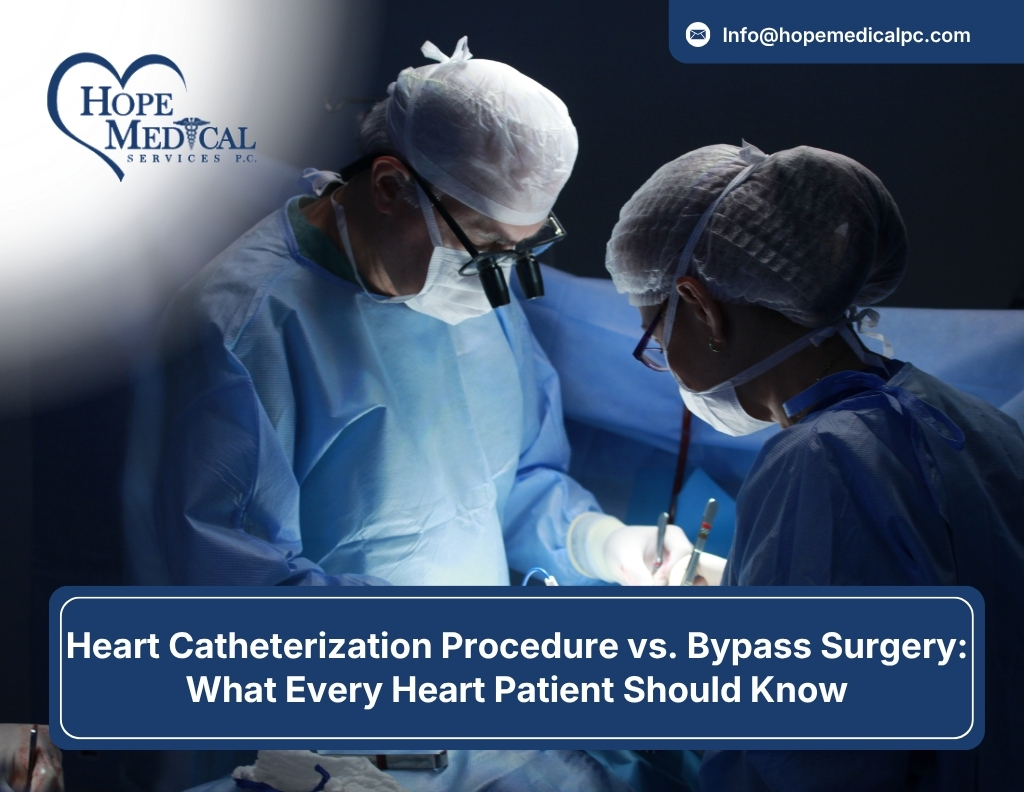
Coronary artery bypass grafting, commonly known as CABG or simply “bypass surgery,” is a more involved, open-heart procedure. Rather than opening the blocked artery itself, surgeons create an entirely new path for blood to flow around the blockage, using a healthy blood vessel taken from another part of the body.
Why It’s Performed
- Multiple coronary arteries are significantly blocked (multi-vessel disease)
- The left main coronary artery, which supplies a large portion of the heart, is severely narrowed
- Angioplasty or stenting isn’t a safe or lasting option due to the location or complexity of the blockages
- A patient has diabetes along with extensive coronary artery disease, where bypass often provides better long-term outcomes
Step-by-Step: What Happens During Bypass Surgery
- You’re placed under general anesthesia for the entire procedure.
- The surgeon makes an incision in the chest to access the heart.
- In many cases, a heart-lung bypass machine temporarily takes over circulation so the surgical team can work on a still heart.
- A healthy artery or vein, often from the chest, leg, or arm, is grafted onto the blocked coronary artery, creating a new route for blood flow.
- Once the graft (or grafts) are in place and blood flow is confirmed, the heart is restarted if a bypass machine was used.
- The chest incision is closed, and you’re moved to intensive care for close monitoring.
Types of Bypass Grafts
| Graft Type | What It Involves |
| Internal Mammary Artery (IMA) Graft | An artery from inside the chest wall is rerouted to the blocked coronary artery; known for long-term durability |
| Saphenous Vein Graft | A vein taken from the leg is used to bypass the blockage; commonly used when multiple bypasses are needed |
| Radial Artery Graft | An artery from the forearm is used, often for patients needing an additional graft |
Catheterization vs. Bypass Surgery: Key Differences
While both procedures address blocked arteries, the scale, invasiveness, and recovery involved are very different. Here’s a side-by-side comparison to help clarify how they compare:
| Factor | Cardiac Catheterization | Bypass Surgery (CABG) |
| Purpose | Diagnose blockages; can treat minor to moderate blockages with angioplasty/stent | Reroutes blood flow around severely blocked or multiple arteries |
| Invasiveness | Minimally invasive; small catheter through wrist or groin | Open-heart surgery requiring chest incision |
| Anesthesia | Local anesthesia with light sedation | General anesthesia |
| Typical Duration | 30–90 minutes | 3–6 hours |
| Hospital Stay | Usually same-day or overnight | 5–7 days on average |
| Best Suited For | Single or double-vessel blockages, diagnostic evaluation | Triple-vessel disease, left main artery blockage, diabetic patients with multiple blockages |
| Recovery Time | Days to about a week | 6–12 weeks for full recovery |
Why These Procedures Are Recommended
Cardiac catheterization and bypass surgery are both used to address coronary artery disease (CAD), a condition in which plaque builds up inside the arteries that supply blood to the heart. Your cardiologist may recommend one of these procedures if you experience:
- Persistent chest pain (angina) that doesn’t improve with medication
- Shortness of breath during light activity or at rest
- Abnormal results on a stress test or echocardiogram
- A prior heart attack with evidence of ongoing blockage
- Known coronary artery disease that is worsening despite lifestyle changes and medication
The choice between catheterization and bypass surgery depends on the number of blocked arteries, their location, your overall health, and how your heart is functioning
How to Prepare for Either Procedure
Preparation looks different depending on which procedure you’re having, but a few general steps apply across the board. Being well-prepared can reduce anxiety and help your recovery go more smoothly.
Before a Cardiac Catheterization
- Avoid eating or drinking for several hours beforehand, as instructed by your care team
- Arrange for someone to drive you home, since sedation affects your ability to drive
- Tell your doctor about all medications and supplements you take, especially blood thinners
- Let your care team know about any allergies, particularly to iodine or contrast dye
Before Bypass Surgery
- Complete pre-operative testing, including bloodwork, imaging, and a physical exam
- Follow instructions about pausing certain medications in the days leading up to surgery
- Arrange for help at home for the first few weeks of recovery
- Ask your care team about pre-surgery conditioning, such as breathing exercises, which can support a smoother recovery
Both procedures also benefit from open communication with your cardiology team. Don’t hesitate to ask questions about anesthesia, expected downtime, or what warning signs should prompt a call to your doctor after you’re home.
Which Procedure Might Be Right for You?
There’s no one-size-fits-all answer. Your cardiologist will weigh several factors before recommending a path forward:
- Number and location of blocked arteries
- Severity of each blockage
- Your heart’s overall pumping function (ejection fraction)
- Other health conditions, such as diabetes or kidney disease
- Your age and ability to tolerate surgery
- Your personal preferences and lifestyle goals
In many cases, catheterization is the first step; it’s used to diagnose the extent of the disease, and depending on what’s found, may lead directly into treatment with a stent or a recommendation for bypass surgery if the blockages are too extensive or complex for a stent alone.
Recovery Timelines: What to Expect
Recovery expectations vary significantly between the two procedures, largely because one is minimally invasive and the other involves open-heart surgery. The table below outlines a general timeline, though your own recovery will depend on your overall health and how your body responds.
| Timeframe | Catheterization Recovery | Bypass Surgery Recovery |
| Day 1–2 | Rest at home; avoid heavy lifting; watch puncture site | ICU monitoring, then transfer to a regular hospital room |
| Week 1 | Light activity resumes; most people return to desk work | Still hospitalized or just discharged; walking short distances |
| Weeks 2–4 | Full activity typically resumed | Gradual increase in walking; driving usually still restricted |
| Weeks 6–12 | Follow-up testing if needed | Cardiac rehab begins; return to work and normal routines |
It’s important to remember these are general guidelines. Your cardiology team will give you a personalized recovery plan, including activity restrictions, medication schedules, and follow-up appointments.
Life After the Procedure: Long-Term Heart Care
Whether you undergo catheterization or bypass surgery, the procedure itself is only one part of protecting your heart long term. Ongoing care makes a significant difference in outcomes and can include:
- Cardiac rehabilitation programs to rebuild strength and stamina safely
- Medication management to control cholesterol, blood pressure, and clotting risk
- Lifestyle changes, including diet, exercise, and smoking cessation
- Regular follow-up testing to monitor heart function over time
For patients managing ongoing heart conditions after a procedure, remote patient monitoring allows your care team to track vital signs from home, catching potential issues early and reducing the need for emergency visits.
When to See a Cardiologist in Queens
If you’re experiencing chest pain, shortness of breath, or have been told you have coronary artery disease, timely evaluation matters. Cardiologists use a combination of tests, including echocardiograms, stress tests, and imaging, to determine whether catheterization, medication, or surgery is the most appropriate next step for your specific situation. Waiting to address symptoms can allow blockages to progress, so early evaluation typically leads to more treatment options and better outcomes.
Final Thoughts
Heart catheterization and bypass surgery serve different purposes, but both share the same goal: restoring healthy blood flow to your heart and protecting you from future complications. Catheterization offers a faster, less invasive path for diagnosis and, in many cases, treatment, while bypass surgery provides a durable solution for more extensive or complex blockages.
The right choice comes down to your unique heart health, and that decision is best made alongside a cardiology team that takes the time to understand your full picture. Hope Medical Services in Queens, NY offers advanced diagnostics, personalized treatment planning, and ongoing support for patients navigating coronary artery disease, from the first consultation through long-term recovery.
FAQs
Q1. Can I go back to work right after a heart catheterization?
Many patients return to light-duty or desk work within a few days, though physically demanding jobs may require a week or more of rest. Your cardiologist will give you specific guidance based on your recovery.
Q2. Will I need bypass surgery if a stent doesn’t work?
Not necessarily, but if a stent isn’t a viable option for a particular blockage or if new blockages develop, your cardiologist may reevaluate and discuss bypass surgery as a longer-term solution.
Q3. Is bypass surgery a permanent fix for blocked arteries?
Bypass grafts can last many years, particularly arterial grafts, but they aren’t guaranteed to last a lifetime. Ongoing lifestyle changes and medication are still important to protect both the graft and the rest of your arteries.
Q4. How many bypasses can be done in a single surgery?
Surgeons can perform single, double, triple, or even quadruple bypasses in one operation, depending on how many arteries are affected.
Q5.Does insurance typically cover these procedures?
Most major insurance plans cover medically necessary catheterization and bypass surgery, though coverage details vary. It’s best to confirm specifics with your provider and your cardiology office ahead of time.
Q6.Can lifestyle changes reduce the need for these procedures in the future?
Yes. Managing blood pressure, cholesterol, blood sugar, and body weight, along with quitting smoking and staying active, can significantly slow the progression of coronary artery disease and reduce the likelihood of needing additional interventions.